Most of our daily behaviour is driven by patterns we never consciously choose, and understanding why is the key to changing them.
From the moment we wake up to the way we respond to stress, our behaviour is shaped by patterns we repeat so often they become automatic. We follow them without thinking, even when they no longer serve us.
If I understand my habits, why is change still so hard?Awareness alone doesn’t rewire behaviour. Habits operate below conscious thought, which is why insight doesn’t always lead to action.

Key Takeaways
- Habits are automatic responses learned through repetition.
- The brain forms habits to conserve energy and increase efficiency.
- Habit loops only become problematic when they support unhelpful behaviours.
- Willpower alone is rarely enough to create lasting change.
- Hypnotherapy works by addressing habits at the subconscious level.
What Is a Habit Loop?
A habit is a behaviour that has become automatic through repetition. Over time, the brain learns that certain actions reliably produce a specific outcome, allowing it to run on “autopilot.”
This process is known as the habit loop, which consists of three elements:
- Cue – the trigger that initiates the behaviour.
- Routine – the behaviour itself.
- Reward – the outcome that reinforces the behaviour.
For example, modern smartphone use illustrates how quickly habitual behaviours can form. On average, people check their phones around 58 times per day, with many of those checks occurring within minutes of one another, often without a conscious intention to do so. [1]
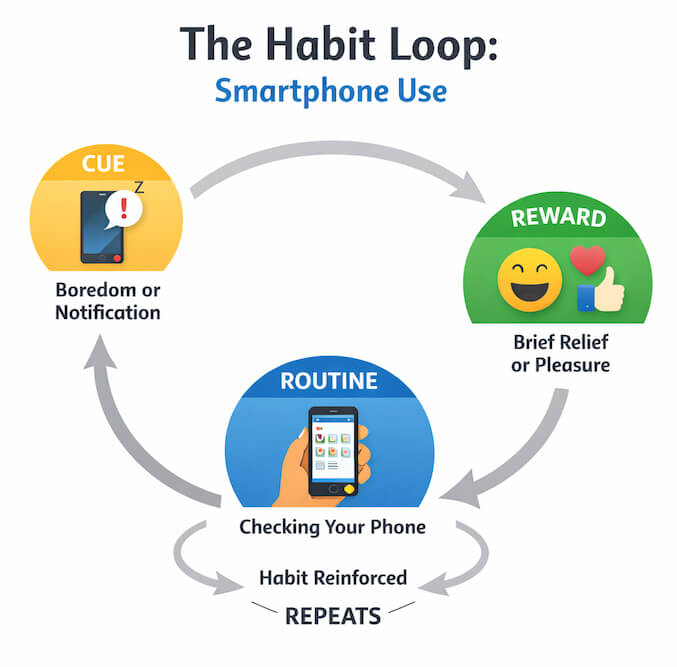
In these moments, a slight feeling of boredom, curiosity, or just noticing the phone (cue) leads to picking it up and scrolling (routine), which delivers a quick burst of stimulation or distraction (reward). Over time, the brain learns to repeat this sequence automatically.
Research in behavioural psychology suggests that a significant proportion of our daily actions are driven by habit rather than conscious decision-making. Studies have shown that as much as 65% of our everyday behaviour may be governed by automatic responses formed through repetition, rather than deliberate choice. [2] These behaviours are triggered by familiar cues in our environment and carried out with little conscious awareness, allowing the brain to conserve energy for more demanding tasks.
This helps explain why habits can feel so deeply ingrained. Once a behaviour becomes automatic, it no longer requires active thought to occur. Instead, it runs in the background, activated by context rather than intention.
Why Does The Body Allow Habit Loops If It Is So Bad For You?
Habit loops exist for a good reason. They are the brain’s way of conserving energy and creating predictability in an otherwise complex environment.
By automating frequently repeated behaviours, the brain frees up mental resources for new or potentially threatening situations. From an evolutionary perspective, this efficiency was essential for survival.
Problems arise when the behaviours being automated no longer serve us. Modern habits, such as excessive screen use, stress eating, or procrastination, can become ingrained in the same way as beneficial ones, even if they negatively impact our health or wellbeing.
The subconscious mind does not discriminate between good or bad habits; it simply repeats whatever behaviour has been learned to produce a familiar or rewarding outcome.
Why Habits Are So Hard to Break
Habits are primarily encoded in the basal ganglia, a region of the brain responsible for automatic behaviours, rather than in the areas involved in conscious decision-making.
That’s why:
- You can know a habit is unhelpful and still repeat it
- Willpower often fails under stress or fatigue
- Telling yourself to “just stop” rarely works
The brain’s priority isn’t self-improvement, it’s efficiency and safety. Once a habit is established, the brain prefers repetition over effort.
This is Why Changing Habits Feels So Difficult
Most people attempt change through conscious effort—motivation, discipline, or positive thinking. While these approaches can help temporarily, they often fail to create lasting change.
That’s because habits do not live in the conscious mind. They are stored in the subconscious, where emotional memory and automatic responses reside. When change efforts rely solely on conscious control, they tend to collapse under stress or fatigue, leading to frustration and relapse.
If habits are formed at a subconscious level, then lasting change must also occur there. This is where hypnotherapy becomes particularly effective.
How Hypnotherapy Interrupts Habit Loops
Hypnotherapy works by gently bypassing the analytical mind and accessing the subconscious, the part of the brain where habits are formed and maintained.
Rather than fighting the habit, hypnotherapy helps to:
- Reduce the emotional charge attached to the old behaviour
- Reframe the meaning of the cue or reward
- Create new associations that feel natural rather than forced
In simple terms, hypnotherapy helps rewrite the habit loop at its source.
As a result, behaviour change often feels easier and more automatic. Many people report that the urge simply fades, because the subconscious no longer links the old behaviour with relief or reward.
How Does Hypnotherapy Bypass the analytical mind and Accessing the subconscious?
The analytical mind is responsible for conscious reasoning, evaluation, and decision-making. This function is largely associated with activity in the prefrontal cortex, the area of the brain involved in planning, judgement, and self-monitoring. While essential for problem-solving, this part of the brain can also act as a gatekeeper, filtering out information that feels unfamiliar or threatening to existing beliefs and habits.
During hypnosis, attention becomes highly focused and internally directed. Brain imaging studies suggest that this state is associated with reduced activity in areas of the prefrontal cortex involved in critical evaluation, alongside increased connectivity between regions involved in attention, emotion, and memory processing.
At the same time, there is increased activity in slower brainwave states, particularly alpha and theta waves, which are associated with relaxation, imagination, emotional learning, and memory consolidation. These states are similar to those experienced during deep focus, meditation, or the moments just before sleep.
If you’re curious about the neuroscience behind how hypnosis affects attention, perception, and behaviour, you can explore this in more detail in our article How Does Hypnosis Work on the Brain? It takes a closer look at the brain processes involved and explains why hypnotherapy can be such an effective tool for lasting change.
Sources
1. Exploding Topics, Time Spent Using Smartphones (2025 Statistics), last updated June 5, 2025, average phone checks per day https://explodingtopics.com/blog/smartphone-usage-stats
2. News-Medical, Daily Actions Are Driven by Habit Rather Than Conscious Choice (September 21, 2025), research showing about 65 percent of daily behaviours are initiated automatically https://www.news-medical.net/news/20250921/Daily-actions-are-driven-by-habit-rather-than-conscious-choice.aspx